
I pull from the same blogging statistics every time I plan content for a WordPress site. The Orbit Media annual blogger survey, HubSpot’s State of Marketing reports, W3Techs platform data. These sources shape every editorial calendar I build, every post length I recommend, and every promotion strategy I put in front of a client.
This page collects the blogging statistics that matter most, organized by category so you can find exactly what you need. Every number links back to a primary source, and I update this page as new survey data drops.
General Blogging Statistics
The blogging landscape keeps growing, but the way people create content has shifted dramatically in the last two years.
- There are over 600 million blogs on the internet, out of 1.9 billion websites worldwide (Statista).
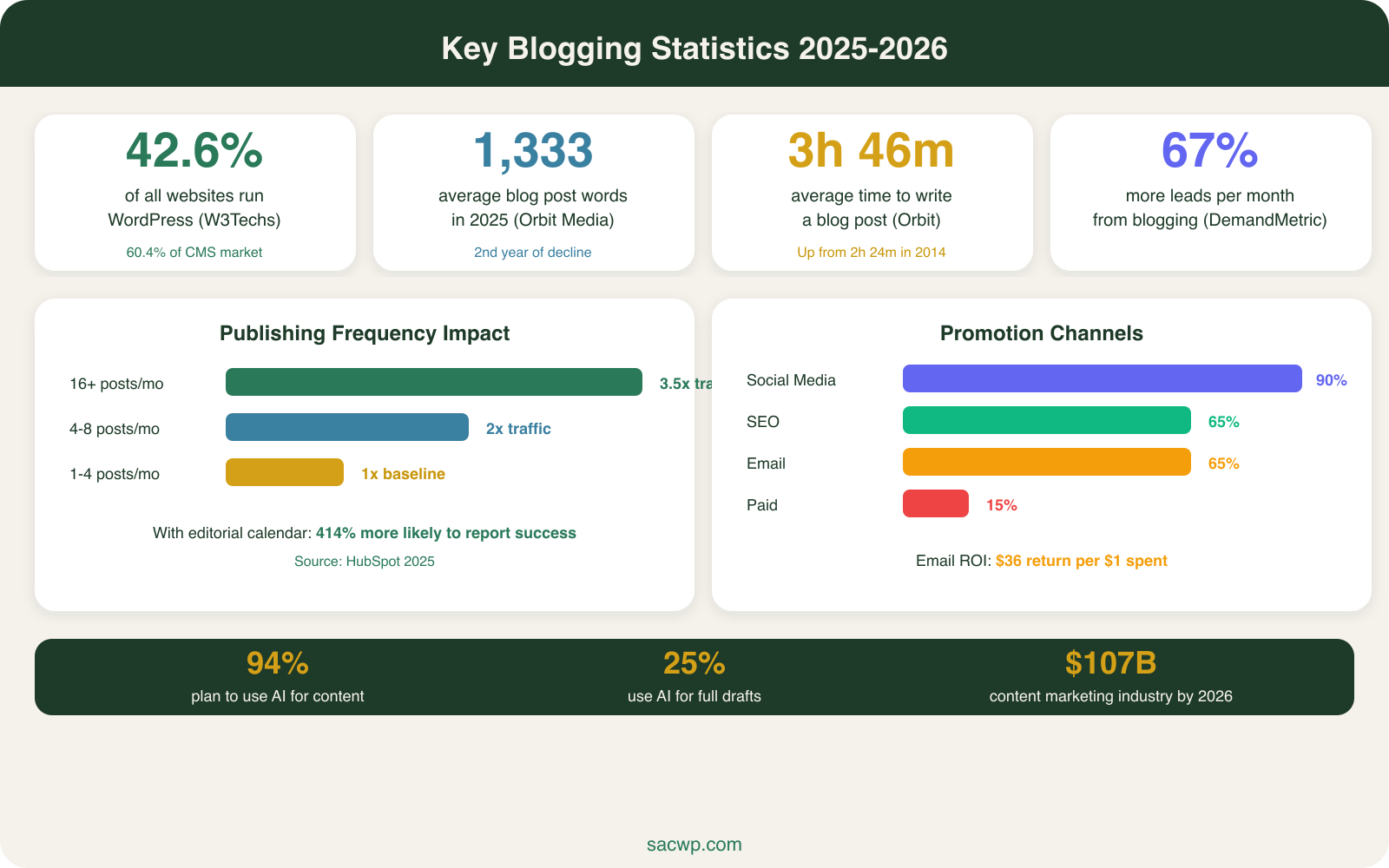
- WordPress powers 42.6% of all websites globally as of early 2026, according to W3Techs. That translates to roughly 60.4% of all sites with a detectable CMS.
- 91.6% of blog websites run on WordPress, making it the dominant platform for content publishing by a wide margin.
- Approximately 7.5 million blog posts are published every single day across all platforms.
- 92% of marketers say blogging drives measurable traffic and leads, according to HubSpot’s 2025 State of Blogging Report.
- Blog posts ranked as the third most popular content format in 2025, used by 38% of marketers, up from fourth place in 2024 (HubSpot).
- 45% of marketers at companies with blogs plan to increase their blogging budget in 2025 (HubSpot).
These numbers confirm what I see in my own client work. Blogging is not declining. The platforms, tools, and tactics are changing, but the demand for written content keeps climbing.
Content Length Statistics
Post length is one of the most debated topics in content strategy. The data from Orbit Media’s 2025 survey of 808 content marketers paints a clear picture.
- The average blog post is 1,333 words in 2025, down from 1,376 in 2024 (Orbit Media). This is the second consecutive year of decline.
- Only 9% of bloggers publish posts longer than 2,000 words.
- But 39% of bloggers who do publish 2,000+ word posts report “strong results,” compared to the 21% benchmark across all post lengths.
- Longer posts earn 77.2% more inbound links than shorter content (Backlinko).
- The average time to write a blog post is 3 hours and 46 minutes in 2025, up from 2 hours and 24 minutes in 2014 (Orbit Media).
The takeaway is straightforward. Most bloggers are writing shorter posts, but the bloggers getting the best results are still investing in longer, more detailed content. I wrote about this tension in my guide to ideal blog post length, and the survey data backs up the conclusion: depth wins when it matters.
Publishing Frequency Statistics
How often you publish affects traffic, but the relationship is not as simple as “more posts equals more visitors.” Here is what the data shows.
- Only 39% of content marketers post at least weekly (Orbit Media).
- There has been a year-over-year increase in biweekly publishing, with about half of all marketers now publishing 2 to 4 times per month.
- HubSpot found that companies publishing 16+ blog posts per month get 3.5x more traffic than companies publishing 0 to 4 posts.
- Bloggers who publish daily are 57% more likely to report strong results, but only 3% of bloggers actually maintain that pace (Orbit Media).
- Consistency matters more than volume. Bloggers who follow an editorial calendar are 414% more likely to report success than those who publish without a schedule.
I cover the frequency question in detail in how often should you blog. The short version: pick a pace you can maintain for 12 months and prioritize quality at every interval.
Content Promotion Statistics
Writing the post is half the job. The other half is getting it in front of people. Most bloggers under-invest in promotion, and the data shows the gap between those who promote and those who do not.
- Over 90% of bloggers use social media to promote their posts (Orbit Media).
- 65% of bloggers use SEO as a promotion channel. 65% also use email marketing.
- Adding social share buttons to posts increases shares by approximately 25%.
- Email newsletters drive 30% of repeat blog visits.
- For every $1 spent on email marketing, the average return is $36.
- Bloggers who spend more time promoting than writing are 20% more likely to report strong results (Orbit Media).
The promotion gap is where I see the biggest missed opportunities on WordPress sites. A solid content promotion strategy paired with an SEO plugin like Yoast or Rank Math can turn a mediocre publishing schedule into a traffic engine.
ROI and Performance Statistics
The bottom line question: does blogging actually produce business results? The data says yes, with some important caveats.
- Website, blog, and SEO content delivers the highest ROI of any marketing channel, according to HubSpot’s 2026 State of Marketing Report.
- 50% of marketers at companies with blogs saw higher ROI from blogging in 2024 compared to 2023 (HubSpot).
- Small businesses are 23% more likely than average to see ROI from blog posts (HubSpot).
- Businesses that blog generate 67% more leads per month than those that do not (DemandMetric).
- The global content marketing industry is projected to reach $107 billion by 2026.
- Blog posts with original research get 74% more backlinks than opinion pieces or how-to content (Orbit Media).
These ROI numbers are why I tell every business owner the same thing: a blog is not a nice-to-have, it is your most durable marketing asset. I break down how to build this from scratch in the content strategy framework guide.
WordPress Blogging Statistics
Since WordPress dominates the blogging platform space, these platform-specific numbers matter for anyone running a WP site.
- WordPress holds 42.6% of all websites and 60.4% of the CMS market as of March 2026 (W3Techs).
- The next closest platform is Shopify at 5.1%, followed by Wix at 4.2%. WordPress has roughly nine times the market share of its nearest competitor.
- Over 65,000 free and premium plugins are available in the WordPress plugin directory.
- Yoast SEO has over 13 million active installs and 829 million total downloads, making it the most downloaded WordPress plugin.
- 35% of WordPress blogs use an SEO plugin like Yoast or Rank Math to optimize posts.
- 72% of WordPress users report significant SEO improvements after installing an SEO plugin.
- The Classic Editor, Yoast SEO, Elementor, and Contact Form 7 each have over 10 million active installations.
These stats reinforce what I see every day building WordPress sites: the plugin ecosystem is a genuine competitive advantage. A well-configured WordPress blog with proper SEO tooling outperforms most proprietary platforms out of the box. I walk through the full WordPress blog SEO setup in a separate guide.
AI and Blogging Statistics
AI adoption has reshaped content creation faster than any trend in blogging history. The 2025 data captures the scale of this shift.
- 94% of marketers plan to use AI for content creation in 2025 (HubSpot).
- The percentage of marketers who do not use AI dropped from 65% to just 5% in the last 24 months.
- 25% of bloggers use AI tools to create full drafts of blog posts (Orbit Media).
- 24% of bloggers use AI to create visuals for their content.
- Marketers who use AI as an editor report the same “strong results” rate as those who use human editors (Orbit Media).
- The average time to write a blog post decreased in 2025 for the first time, likely driven by AI adoption.
AI is changing the speed of production, but it is not changing what works. The fundamentals in the data, longer posts, consistent publishing, active promotion, those patterns hold regardless of how the first draft gets written.
How many blogs exist in 2026?
Over 600 million blogs exist across the internet as of 2026, according to Statista. WordPress alone powers the vast majority of these, with 91.6% of blog websites running on WordPress. The number grows every year, but the percentage of blogs that attract meaningful traffic remains small. Consistent publishing and SEO are what separate active blogs from abandoned ones.
What is the average blog post length?
The average blog post is 1,333 words in 2025, according to Orbit Media’s annual blogger survey. That number has declined for two consecutive years. However, posts over 2,000 words still outperform shorter content by a significant margin, with 39% of long-form bloggers reporting strong results versus the 21% average.
Does blogging still work for SEO?
Yes. Website, blog, and SEO content is the highest ROI marketing channel according to HubSpot’s 2026 State of Marketing data. Businesses that blog generate 67% more leads per month than those that do not. The key is pairing quality content with proper on-page SEO and a consistent publishing schedule.
How often should a business blog?
Most successful bloggers publish 2 to 4 times per month. HubSpot data shows that companies publishing 16+ posts per month get 3.5x more traffic, but consistency matters more than raw volume. Bloggers who follow an editorial calendar are 414% more likely to report success. I recommend starting with a sustainable pace and scaling up as you build a library of quality content.
These blogging statistics shape every content recommendation I make for WordPress clients. The data points toward the same playbook year after year: write thorough content, publish on a schedule, promote beyond social media, and measure what comes back.
If you are building a WordPress blog or rethinking your content strategy, I can help you apply these numbers to your specific situation. Get in touch and let’s turn the data into a plan.